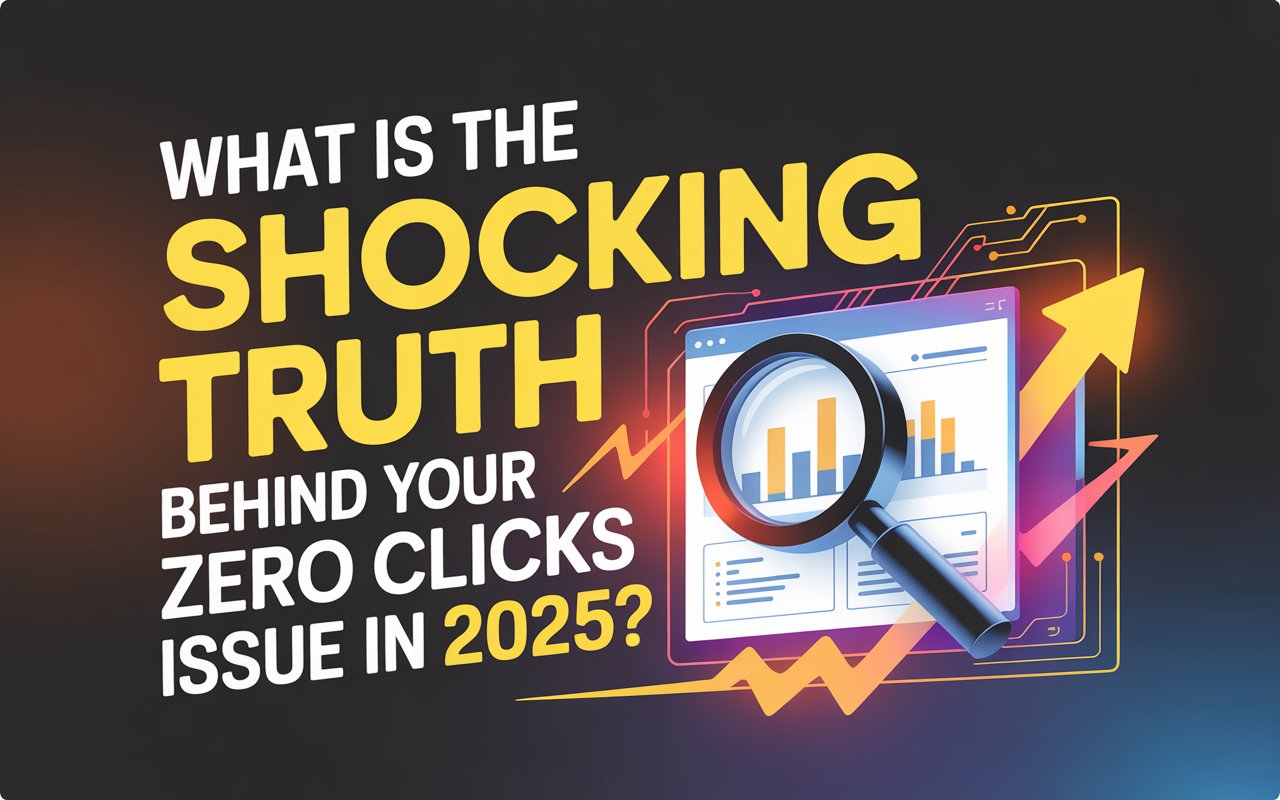
You check your website analytics, and something feels off. The numbers don't add up. Your content ranks well. Your impressions are climbing. But the clicks? They're vanishing into thin air. Welcome to the zero-click reality of 2025, where your perfectly crafted content gets seen but never visited.
Let me be straight with you: this isn't a glitch in your tracking software. It's the new normal, and it's reshaping everything you thought you knew about online visibility.
What's Actually Happening Here?
Imagine searching for "best time to plant tomatoes" and getting a complete answer right there on your screen. No clicking required. That's a zero-click search, and it's dominating the internet landscape right now.Currently, around 60% of all search queries end without anyone clicking through to a website. Think about that for a second. More than half of all searches are dead ends for website owners. On mobile devices, it's even worse, with approximately 77% of searches ending without a click.
This isn't some distant future scenario. It's happening on your phone right now, every time you search for a quick fact, a store's hours, or tomorrow's weather forecast.
Why Your Clicks Disappeared (And It's Not Your Fault)
Here's where things get interesting. Several forces are working together to create this perfect storm of clicklessness.
First up: artificial intelligence summaries. Search engines now pull information from multiple sources and serve it to you in neat, digestible packages. You get your answer instantly, synthesized from ten different websites, without visiting any of them. Tools like AI Overviews provide clear, concise snippets that eliminate the need for users to click through to websites.
Then there's the mobile explosion. When you're staring at a tiny screen, you want speed, not an adventure through multiple web pages. Featured snippets, knowledge panels, and instant answer boxes cater perfectly to this need for immediate satisfaction.
Voice search and smart speakers have also normalized answer-first experiences, where users expect immediate responses without needing to browse multiple websites. Ask your smart speaker a question, and it doesn't read you a list of websites to visit. It just gives you the answer.
But here's the kicker: many queries now route users to other platforms within the same ecosystem, such as maps, videos, or flight information, keeping them from ever leaving to visit external websites. The internet isn't getting smaller, it's just getting more contained.
The Real Impact (Spoiler: It's Complicated)
Now, I'll be honest with you. I can't predict exactly how this will affect every single business or website. The data we have is recent, but the trend is still evolving. What we do know is sobering, though.
News publishers experienced a significant decline, with visits dropping from 2.3 billion in 2024 to under 1.7 billion by May 2025. That's not a small dip. That's a nosedive that would make any publisher's stomach turn.
For certain industries like health information, quick recipes, or basic how-to guides, the impact could be devastating if you're still playing by the old rules. But here's the thing: some brands are actually seeing traffic increases. How? They've figured out how to show up in those AI summaries and featured snippets in ways that make people curious enough to click through for more. Even the best SEO serices agency will tell you that visibility without clicks is the new challenge everyone's trying to crack.
The painful truth is that being seen no longer guarantees being visited. Your content might appear in dozens of AI-generated answers every day, helping thousands of people, and you'd never see a single visitor from it.
What You Can Do About It (Because Doing Nothing Isn't an Option)
Let's talk solutions, because complaining about change doesn't pay the bills.
First, shift your mindset from traffic to visibility. I know this sounds like consolation prize thinking, but hear me out. If your brand name appears in featured snippets and knowledge panels, that's advertising you didn't pay for. People see you as an authority even if they don't click through immediately. They remember you for later.
Second, optimize specifically for those answer boxes and featured snippets. Structure your content with clear questions and concise answers. Use simple language. Break complex topics into digestible chunks. Think like you're writing for someone who's standing at a bus stop with thirty seconds to spare.
Create content that can't be summarized in a snippet. Deep analysis, unique research, tools and calculators, personal experiences, these are things that require a full visit to appreciate. You can't get the full value from a two-sentence summary.
Build your brand presence everywhere. The internet is becoming less about single websites and more about integrated platforms. Show up on video platforms, discussion forums, professional networks. Be where your audience already hangs out, not just where you want them to visit.
The Uncomfortable Truth About Conversions
Here's something that doesn't get talked about enough in all these situations: clicks aren't always conversions anyway.
Would you rather have 1,000 random visitors who bounce immediately, or 50 highly qualified visitors who found you through a featured snippet and actually need what you offer? Some marketers are finding that while AI features may reduce overall clicks, the visitors who do click through from these enhanced results are often more qualified and more likely to convert.
Quality over quantity isn't just a motivational poster slogan. It's becoming a survival strategy.
Where This Is All Heading (And What Nobody's Sure About Yet)
Let's tell you what we don't know, because there's still a lot of uncertainty surrounding this whole situation.
Projections suggest zero-click searches could surpass 70% by 2025, but predictions are tricky when technology moves this fast. Will search engines find a better balance between user convenience and publisher sustainability? Will new monetization models emerge that fairly compensate content creators whose work feeds these AI summaries? Will users eventually tire of surface-level answers and crave deeper engagement again?
I genuinely don't know. What I do know is that sitting still while the internet transforms around you is a guaranteed way to become irrelevant.
The future probably won't look like a return to 2015, when clicking through was the standard user behavior. Instead, we're heading toward something more complex, a hybrid world where visibility, authority, and strategic clicks matter more than raw traffic numbers.
The websites that survive and thrive won't be those mourning the death of the click. They'll be the ones who figured out how to provide value in a zero-click world while still maintaining reasons for people to visit when it matters most. They'll be creating content so valuable that an AI summary feels like a movie trailer, not the full feature film.
Your shocking truth? The clicks aren't coming back. But opportunity hasn't left the building. It's just wearing a different outfit now, and it's time you got acquainted with its new look.
Frequently Asked Questions
Q: What exactly is a zero-click search?
A: It's when you get your answer directly on the search results page without clicking any website. Think featured snippets, instant answers, or AI summaries.
Q: Are zero-click searches hurting websites?
A: For sites relying on traffic and ads, yes. But some find that fewer, more qualified visitors actually convert better than high traffic with low engagement.
Q: Can I still succeed with content marketing?
A: Yes. Focus on appearing in snippets for visibility while creating deeper content that requires a full visit, like tools, detailed analysis, and unique research.
Q: Will this trend reverse?
A: Unlikely. Data suggests it'll keep growing past 70% of searches. The better question is how to adapt rather than waiting for change.
Final Words
The era of the click isn’t ending — it’s transforming. Success in 2025 isn’t about counting visitors but about being seen, trusted, and remembered when it matters most. The brands that understand this shift are the ones quietly building authority while others chase disappearing traffic.
Those struggling with zero-click searches can still adapt by focusing on deeper value, structured content, and multi-platform visibility. The key is learning how to turn exposure into influence — even when clicks don’t immediately follow.
For anyone looking to stay ahead of these changes, Best SG SEO Services stands out as a prime example of how modern SEO can evolve with the times. Their approach reflects the balance between data-driven optimization and authentic audience engagement that defines success in a zero-click world.
The truth is simple: visibility has a new definition, and adaptation is the only real metric that matters now.